The AI Timeline: From Turing to ChatGPT
AI evolved from theoretical concepts in the 1950s to today's business automation tools, reshaping competitive strategy.
TL;DR
Artificial Intelligence has evolved from theoretical ideas in the 1950s to the everyday business tools we use today. Understanding this journey helps leaders see that AI isn't a futuristic concept but a mature, rapidly improving technology driving competitive advantage. In this article, you'll learn key milestones in AI's development and how each breakthrough paved the way for practical applications like automation, analytics, and copilots.
Introduction
Every transformative technology starts with a spark. For AI, that spark came when Alan Turing asked a simple question: "Can machines think?" Fast forward seventy years, and AI is not just thinking — it's optimizing, predicting, and transforming how businesses operate.
Many leaders view AI as something that suddenly exploded with ChatGPT. In reality, it's the product of decades of research, iteration, and technological convergence. This timeline will help you connect the dots between AI's past, its rapid progress, and where it's heading next for business innovation.
Why it matters
Understanding AI's evolution isn't just academic — it's strategic. Every phase of AI's history brought new capabilities that directly shaped modern business operations.
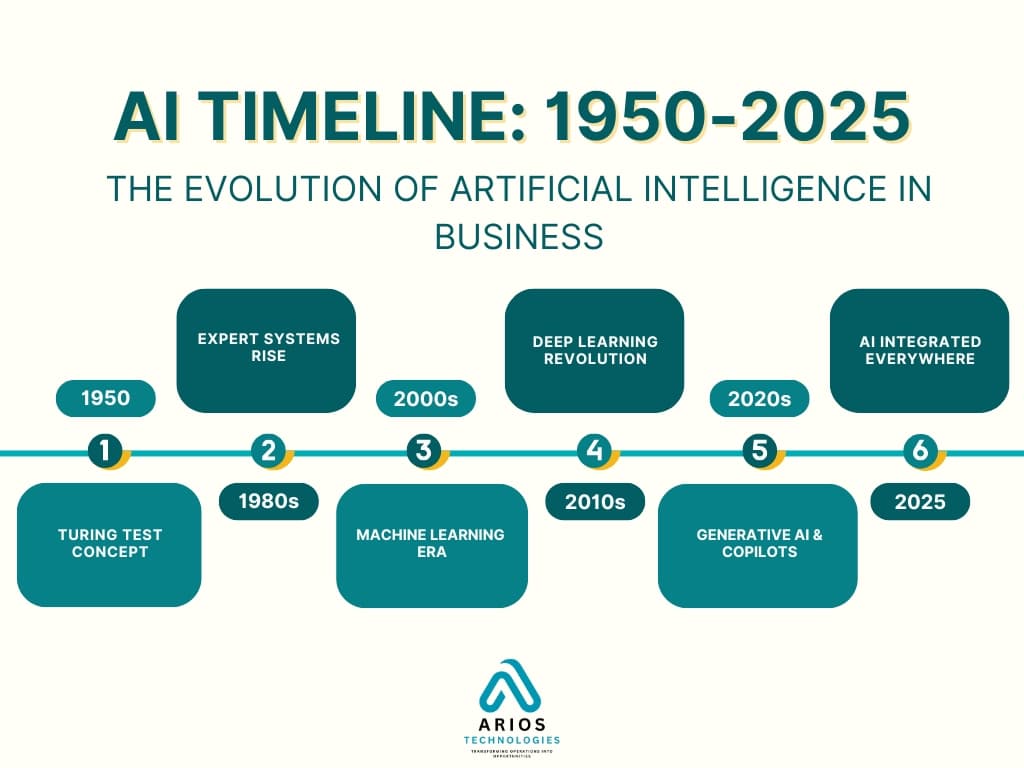
- 1950s-1970s: logic-based reasoning laid the foundation for decision automation.
- 1980s-1990s: the rise of machine learning introduced adaptability and pattern recognition.
- 2000s-2010s: big data and GPUs unlocked deep learning, enabling visual and language models.
- 2020s: generative AI is democratizing automation, bringing "intelligence" to every tool and workflow.
Leaders who recognize these cycles can better anticipate what's next. As AI becomes embedded in CRMs, ERP systems, and analytics dashboards, understanding its historical path provides clarity on where to invest, integrate, and innovate.
Understanding AI's evolution in practice
1950s-1960s: the birth of AI
- Key milestone: Alan Turing proposes the "Turing Test" (1950).
- Innovation: logic and symbolic reasoning dominate early AI.
- Example: early chess programs and theorem solvers.
1970s-1980s: expert systems and knowledge engineering
- Key milestone: MYCIN and DENDRAL pioneer medical and chemistry expert systems.
- Innovation: AI systems begin mimicking human expertise in narrow domains.
- Example: diagnosing infections, financial decision support.
1990s-2000s: machine learning and the data era
- Key milestone: algorithms like decision trees, support vector machines (SVMs), and neural networks evolve.
- Innovation: AI starts learning from data rather than hard-coded rules.
- Example: spam filters, credit scoring, and early recommendation engines.
2010s: deep learning and the rise of big data
- Key milestone: breakthroughs like AlexNet (2012) and AlphaGo (2016).
- Innovation: neural networks outperform humans in image and pattern recognition.
- Example: self-driving cars, speech-to-text, and facial recognition.
2020s: generative AI and the democratization of intelligence
- Key milestone: GPT-3 (2020), ChatGPT (2022), and GPT-4o (2024) reshape public perception.
- Innovation: AI now creates text, images, video, and code.
- Example: Microsoft Copilot, Jasper, Midjourney, and Azure AI Studio.
How AI's evolution works in business today
Each stage of AI's timeline corresponds to business systems that matured alongside it:
- Rule-based automation (1950s-1980s): Excel macros, if-then business logic in ERP systems. Reduced manual data entry and standardized workflows.
- Machine learning (1990s-2010s): Power BI, Azure ML, Python libraries like scikit-learn. Forecasting, fraud detection, and predictive maintenance.
- Deep learning & neural networks (2010s): Azure Cognitive Services, TensorFlow, PyTorch. Visual inspection, voice assistants, sentiment analysis.
- Generative AI (2020s): Azure AI Foundry, OpenAI API, Power Automate Copilot. Automating documentation, customer support, and creative content.
Evaluate where AI can add value
AI's history offers a mirror for leaders to evaluate their own readiness. Every successful AI era thrived on one thing: clarity of purpose. Before you adopt the latest tool, ask these three questions:
- Where are our biggest inefficiencies? Look for repetitive, rules-based tasks that drain time but yield little strategic value.
- What data do we already have, and can we trust it? Data quality determines AI quality. Most failed AI projects stem from poor data hygiene, not bad algorithms.
- Do our teams understand the "why"? Adoption works best when employees see AI as an enabler, not a threat.
Prioritize pilot projects that automate low-risk processes first. Then, measure ROI in hours saved, errors reduced, and decision speed gained. The organizations that balance experimentation with measurement are the ones that move from hype to sustained advantage.
Business impact
Companies that learn from AI's evolution position themselves ahead of disruption. McKinsey estimates that AI can boost productivity by up to 40% across knowledge-based roles, while Gartner predicts that 80% of enterprises will have embedded generative AI in their core systems by 2026.
Early adopters are already seeing:
- 25-40% task reduction through intelligent automation.
- 15-25% improvement in customer satisfaction from personalized experiences.
- 20-30% faster decision cycles from AI-augmented analytics.
AI's maturity means the question is no longer if but where to apply it next. Those who understand the journey, from Turing to ChatGPT, can make smarter, more strategic bets on where AI will drive the next wave of operational efficiency and innovation.
Conclusion
AI's story is not about machines replacing humans; it's about humans extending their capabilities. The same curiosity that drove Turing to ask, "Can machines think?" now drives organizations to ask, "How can AI help us think better?"
The arc from theory to application shows that progress favours those who experiment, adapt, and learn. By studying the path from rule-based systems to generative copilots, you're not just looking at history — you're mapping your competitive future.
Arios Technologies helps businesses transform that understanding into action, turning operations into opportunities through responsible, practical AI adoption.
Frequently asked questions
When did artificial intelligence begin?
Artificial intelligence began as a formal research field in the 1950s, although many of the mathematical and philosophical ideas behind it appeared earlier.
Why did AI become practical for businesses recently?
AI became practical because cloud computing, large datasets, open-source models, GPUs, and user-friendly interfaces made advanced AI capabilities easier and cheaper to apply to real workflows.
What is the next phase of AI for business?
The next phase is agentic AI, where systems do more than generate answers; they execute multi-step workflows, use tools, remember context, and coordinate work across business systems.